

How Cochlear Implants Help Restore Hearing in Severe Hearing Loss
January 22, 2026
Severe hearing loss carries a deeper weight than most people realise. It affects communication, confidence and often isolates people from everyday life. Reports from international hearing health surveys show that millions of individuals live with hearing loss so advanced that regular hearing aids cannot help them anymore. This group includes children born with significant hearing impairment and adults who lose hearing due to illness, ageing or long exposure to loud sound. For many of them, a cochlear implant opens a door they thought was permanently closed.
The human ear works in a beautifully complex way. Sound enters the outer ear, travels to the middle ear and finally reaches the inner ear where tiny sensory cells convert vibrations into signals for the brain. When those inner ear cells are damaged, the pathway breaks down. No matter how loud a sound is made, the signals simply do not reach the brain clearly. That is why some patients say they can “hear something” but cannot understand speech. The clarity is lost.
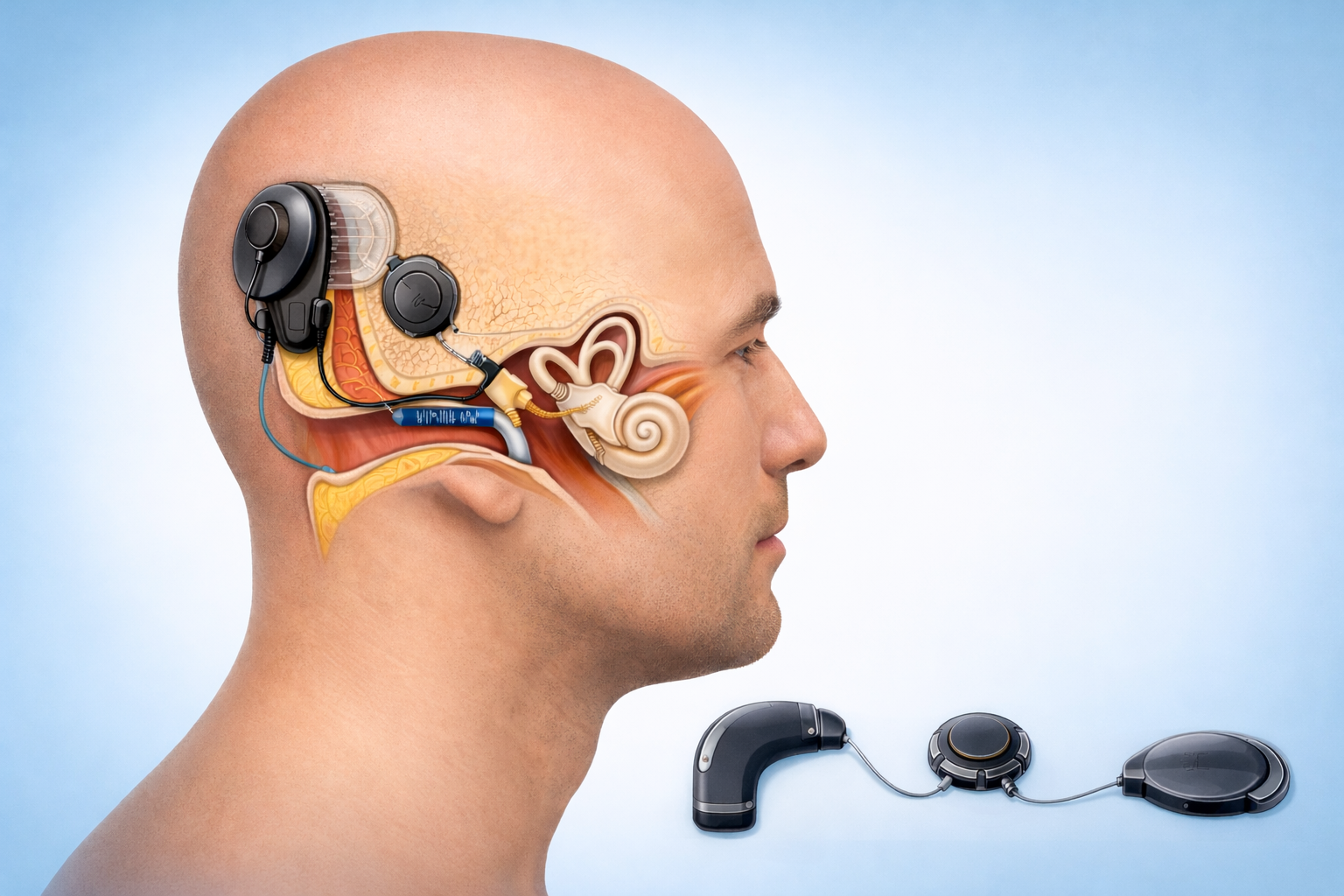
A cochlear implant takes a different approach from a hearing aid. Instead of increasing volume, it creates a new route for sound to reach the brain. The system has an external part that picks up sound and processes it. The internal part, placed in the cochlea during a surgical procedure, stimulates the auditory nerve directly with electrical impulses. The brain receives these impulses and slowly learns to interpret them as meaningful sound.
The change does not happen in a single moment. Once the implant is switched on, the first sounds may feel unfamiliar. Over time, through regular listening and therapy, the brain begins to adapt. Children who receive the implant early often show remarkable progress in language development because their brains are still forming pathways for speech. Adults who once had normal hearing usually adapt more quickly because their brain remembers what speech sounds like.
The practical difference in daily life is enormous. Many patients describe hearing their family clearly for the first time in years. Others talk about simple joys returning, like listening to music or hearing footsteps approaching. For some children, the implant allows them to pick up spoken language in a way that was previously impossible.
A cochlear implant is recommended only after careful evaluation. Audiologists test the patient’s hearing range, ENT specialists study the structure of the inner ear and speech experts assess communication ability. When a person qualifies, the implant often becomes a life-changing step.
At Anand ENT Hospital in Coimbatore, specialists guide families and patients through every stage of the cochlear implant journey, from evaluation to surgery to rehabilitation. If severe hearing loss has made communication difficult, our team is here to help you explore whether a cochlear implant can restore the sounds that matter most.